Last Updated: March 2026
My neighbor runs a catering business. Has for years. Three guys on his crew, a commercial kitchen he rents, decent bookings year-round. Last spring I asked what he was paying for insurance.
Four thousand two hundred dollars a year. I almost choked.
He had no idea he was overpaying. Just kept renewing the same stack of policies because nobody ever pulled him aside and said — look, there’s a completely different way to handle this. His broker never brought it up. He never thought to ask. It just kept going.
I told him about BOP Insurance. He’d genuinely never heard of one. A few months later he called me — switched everything over, now paying $684 a year. Better coverage than before. And $3,500 back in his pocket, which he used to hire a part-time driver so he could finally stop turning down jobs on the other side of town.
That whole situation shouldn’t have taken as long as it did. But it does, constantly, for business owners everywhere.
So let me just walk you through what a BOP actually is — because there’s a real chance your setup looks a lot like his did.

What Is a BOP, Exactly?
BOP stands for Business Owner’s Policy. It’s a bundle. Instead of buying three or four types of coverage separately, you get the core stuff packaged into one policy — and you pay less for it than you would piecing it all together.
A standard BOP Insurance covers two main things.
Property coverage. Your physical stuff — building if you own it, equipment, inventory, furniture. Fire breaks out. Pipe bursts overnight. Storm wipes out the front of your shop. Property coverage pays to fix or replace what got destroyed.
General liability. For when your business causes harm to someone else. Customer slips at your place and ends up in urgent care. Client says your work cost them money. Someone claims your crew damaged their property on a job. This coverage handles the legal back-and-forth and whatever comes out at the end of it.
Many BOPs also include business interruption coverage — and this is the one that surprises people. It doesn’t just cover the damage itself. It covers the income you couldn’t make while you were shut down waiting for repairs. Fire closes you for six weeks? Business interruption pays what you would’ve earned during those six weeks. People don’t realize that’s part of the policy until they actually need it, and then they’re very glad it’s there.
Pricing: roughly $57 a month, about $684 a year based on what the market looked like through 2025 and into 2026. Buy property coverage alone — that’s around $804 a year. Add a standalone general liability policy at around $500. You’re already past $1,300 and haven’t touched business interruption yet. The bundled price just beats that by a lot.
BOP vs. General Liability — Not the Same Thing
I hear people use these terms interchangeably constantly. They’re not the same.
General liability is one policy covering one thing. Someone outside your business gets hurt or has their property damaged because of something your business did, and they come after you. That’s all it does. Nothing else in the box.
A BOP contains general liability — wrapped inside a lot more coverage.
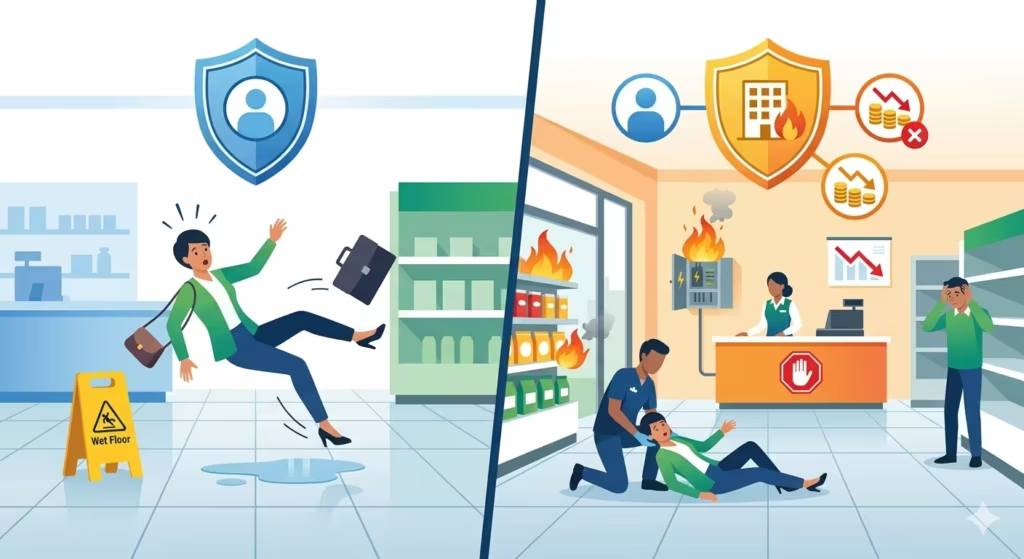
Here’s the clearest way I can show the gap. Customer trips on your front step, breaks her wrist. GL covers it. BOP covers it too. Identical on that claim.
Week later, bad storm. Roof is gone. You’re shut down three weeks waiting for contractors. What does your GL policy pay toward that?
Not one dollar. It doesn’t apply. Wasn’t built for that situation.
Your BOP covers the roof repair. It also covers the three weeks of revenue you lost sitting there watching the work happen.
Say your business brings in $10,000 a month. Three weeks closed is $7,500 gone — and your general liability policy just watches. That’s the gap.
People spend a lot of time worrying about lawsuits. Fair enough — the average slip-and-fall claim runs around $45,000, which is genuinely scary. But what tends to actually close businesses isn’t usually the lawsuit. It’s the weeks or months with no money coming in and all the same bills going out.
Do You Need One?
Most small business owners, yes.
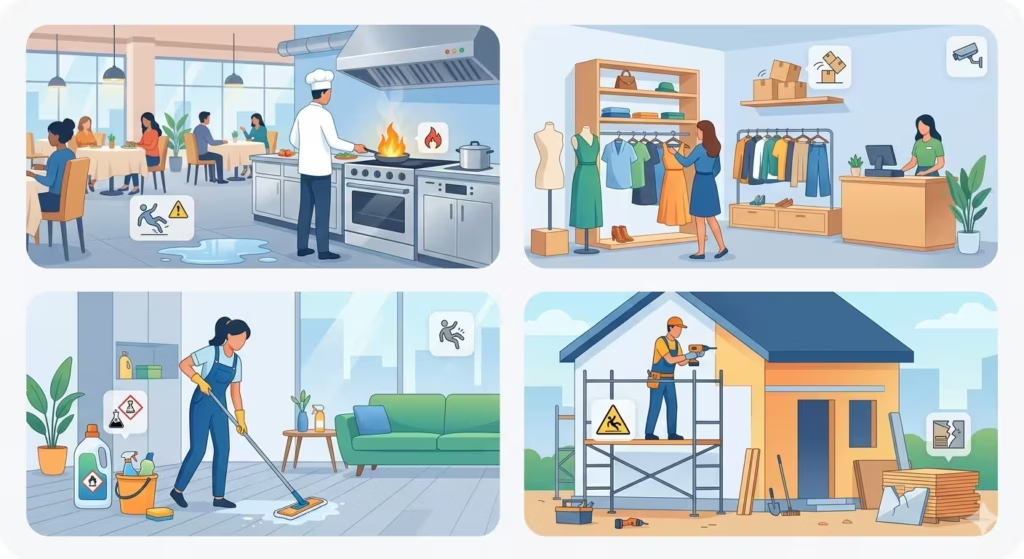
Physical location where people show up — customers, employees, doesn’t matter — you need property coverage. Something goes wrong with that space and you need to be protected. Storefront, rented kitchen, salon, repair shop, job site — doesn’t matter what kind.
You deal with the public regularly — restaurant, retail, cleaning service, contractor, landscaping, any kind of service business — you need liability protection sized for that level of exposure.
Under 100 employees, under $5 million in revenue? You probably qualify for a BOP without even needing to dig into the details.
The person who might genuinely not need one: solo consultant, works from home, clients never visit, nothing much to protect physically. A standalone GL might honestly be enough for that person.
Anyone else with equipment, a rented space, employees doing work out in the world — a BOP was built for that. And if you’re running a restaurant, boutique, cleaning company, photography studio, any service business with a real physical footprint — and you don’t have one right now — you’re probably overpaying and underinsured at the exact same time. Both. Simultaneously.
The Gaps — and They’re Real
Buy a BOP and assume you’re covered for everything. That’s the mistake. The exclusions are real and they tend to stay quiet until you’re filing a claim.
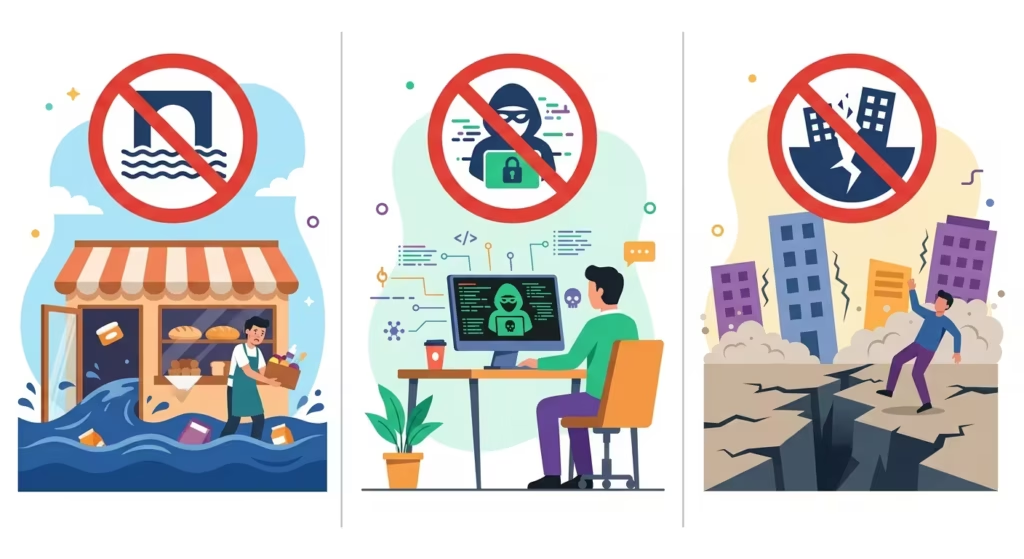
Flooding and earthquakes aren’t covered. At all. Standard BOP, standard commercial property — neither one pays for flood damage from rising water. If your business sits near water or in a region with seismic activity, you need separate riders for those. A lot of people find out the hard way, after the water’s already inside.
Cyber incidents — data breach, ransomware, someone stealing your customer payment data — none of it is in a standard BOP. Zero coverage. Cyber is a completely separate policy. In 2026, skipping it is a genuine risk. Median cost runs around $145 a month.
Professional liability — Errors and Omissions. Give professional advice, deliver work that a client claims was wrong or careless, and your BOP won’t help you when they sue over it. That’s what E&O coverage is for. Separate policy, separate claim type, and a lot of service businesses that need it don’t have it.
Commercial auto — your team driving for work purposes isn’t covered under a BOP. Deliveries, hauling equipment, visiting clients. Their personal auto policies don’t cover business-related driving either. Commercial auto is its own thing.
Business interruption triggers — read this one carefully. Some policies only pay business interruption benefits when there’s physical damage to your actual property. Supplier collapses. Government forces you to close. Supply chain falls apart with no damage to your building. Depending on how your policy is written, it might not pay anything in those situations. Ask your broker to walk through the trigger language specifically before you sign. That’s the one that always seems like a small detail until it isn’t.

What the Savings Actually Look Like
Small retail shop. Real numbers.
Separately: general liability around $500 a year, commercial property around $804, business interruption on top for another $400 to $600. Total somewhere between $1,700 and $1,900, minimum.
Through a BOP: around $684 a year. Same three pieces, one policy.
That’s over a thousand dollars saved before doing anything else.
Stack bundling on top — putting everything with one carrier typically saves another 20% or more. Pay the full annual premium upfront instead of month to month and you usually save another 15%. One check, once, and the carrier rewards you for it.
For a business paying $1,500 a year, the upfront-payment discount alone saves $225. Small in isolation. Combined with the 20% bundling discount and the BOP structure over separate policies, the year-end number looks quite different.

What Controls Your Premium
Underwriters look at real things. Knowing what they look at means you can actually do something about it.
Claims history. Filed claims go in your record. Multiple claims push premiums up fast. Some owners pay smaller claims out of pocket deliberately, keeping their record clean for genuinely catastrophic events. Worth talking through with your broker — not the right move for everyone, but a real option.
Your location. High-litigation counties, high-crime areas — higher premiums. You can’t relocate for an insurance discount, but knowing this affects how you plan.
Employee classifications. Workers’ comp rates depend on job types. Misclassify a roofer as office staff and you pay for it at audit time — sometimes retroactively by a year or more. Painful.
Documented risk management. Most underused lever on the list. Safety training logs, two-factor authentication on your systems, return-to-work programs — documented proof your operation has real controls in place. Show that to an underwriter and you become a lower-risk account. Lower risk, lower premium. Straight line between the two.
One Carrier or Multiple?
For most small businesses, one carrier. Bundling gets you the 20% discount, one renewal date, one contact, one claims process. Simpler.
Exceptions exist — some carriers are genuinely better at specific coverage types. Unusual or complex risk, specialized equipment, tech operations — worth asking your broker if a specialty carrier makes sense for one particular piece while the rest stays bundled.
But the bigger thing is just having a real ongoing relationship with a broker who knows your business. Someone who calls before renewal to see if anything changed — not after a claim to explain what wasn’t covered. That’s worth more than most people give it credit for.
Common Questions
What does BOP stand for? Business Owner’s Policy. Bundled commercial insurance — general liability, commercial property, business interruption — built specifically for small businesses.
Isn’t BOP just general liability? Nope. GL is a narrow policy covering third-party injury and damage claims only. A BOP has GL inside it plus property and business interruption coverage. More coverage, lower price than buying each piece separately.
What does it typically cost? Around $57 a month, $684 a year based on current market data. High-risk industries pay more. Plenty of businesses come in under $100 a month. Others pay a few thousand depending on size and type.
Does it cover data breaches? No. Standard BOPs don’t touch cyber incidents. Separate policy, around $145 a month in 2026.
Who qualifies? Small businesses — physical location, under 100 employees, under $5 million revenue. Varies by carrier and industry. High-risk operations sometimes need specialized coverage.
Biggest BOP mistake? Assuming it covers everything. Flood, earthquake, cyber, professional liability, commercial auto — all excluded. Second biggest: not reading the business interruption trigger before buying. Nobody thinks about that until the moment it matters.
My neighbor hired the driver. Takes jobs all over the city now. Business is actually growing.
One conversation. Should’ve happened years earlier.
Worth having before your next renewal. Not after something goes wrong.
Disclosure: This blog may contain affiliate links. If you click and purchase, we may earn a commission at no extra cost to you. We only recommend products we have independently reviewed.
Disclaimer: This article is for informational purposes only and is not legal or financial advice. Insurance needs vary by business type, location, and risk. Speak with a licensed insurance broker before making coverage decisions.