
You know that sinking feeling.
You booked the trip months ago — flights, hotel, the little food tour you were weirdly excited about. You paid. It’s done. And now something’s come up that has nothing to do with illness or hurricanes or any of those tidy “covered reasons” your insurance company loves to list in tiny print.
Maybe the news out of your destination went sideways. Maybe your kid’s thing lands on that exact weekend. Maybe — and I’ve heard this more times than you’d think — you just don’t want to go anymore.
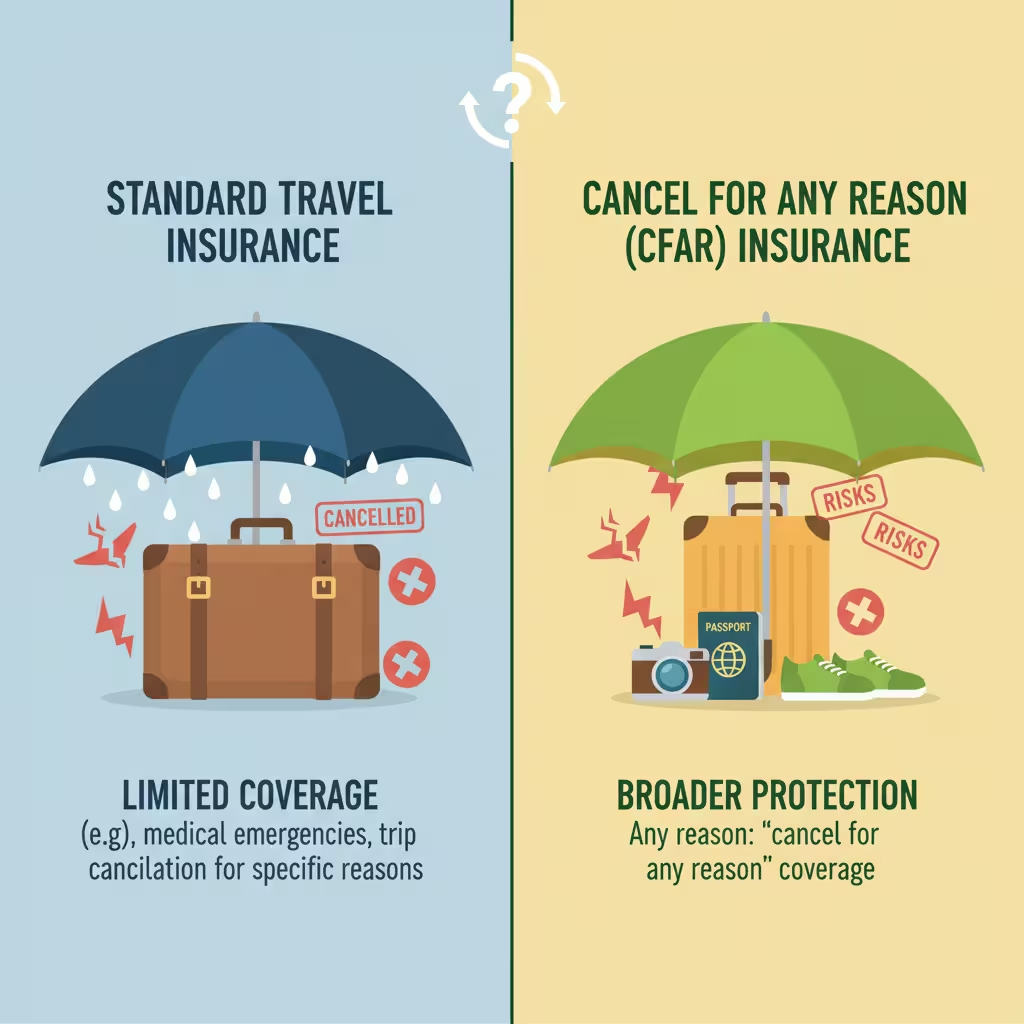
Standard travel insurance? It won’t touch that. It only pays when something specific happens. Something provable. Something on the list.
That’s the gap. And that’s exactly what cancel for any reason travel insurance — CFAR, if you want the short version — was built to fill.

So What Is CFAR, Actually?
Here’s the plain version: CFAR is an optional add-on to a regular travel insurance policy. It lets you cancel your trip for literally any reason and still walk away with some of your money back. No documentation. No doctor’s note. No filing a claim that may or may not get approved.
You cancel. You get reimbursed. Done.
That reimbursement won’t be the full amount — we’ll get to that — but it’s real money back on a trip you otherwise would’ve eaten entirely.
The thing most travelers don’t realize is that standard trip cancellation, as generous as it can sound, only protects you inside a narrow box. Illness, death in the family, severe weather, jury duty. That’s roughly it. Anything else? You’re on your own.
CFAR blows that box wide open.

The Part Where CFAR Gets Complicated
Look, here’s the thing: CFAR isn’t a blank check. It comes with three rules that are genuinely strict, and if you miss any one of them, the whole thing falls apart.
Rule one is the killer. You have to buy CFAR within 10 to 21 days of your very first trip deposit. Not the day before you fly. Not three weeks after you booked your hotel. The clock starts the moment money leaves your account for this trip — any money, any vendor. Some insurers cap the window at 14 days. A handful go up to 21. But miss it? CFAR is gone. No exceptions, no appeals, no “I didn’t know.”
Rule two is about commitment. Most policies require you to insure 100% of your non-refundable trip costs to qualify. That means if you’ve paid $5,000 in prepaid, non-refundable expenses, you need to insure $5,000. Not $3,500. Not “the expensive parts.” All of it.
Rule three catches people off guard. CFAR has a hard 48-hour cutoff before departure. Woke up sick on travel day and want out? Too late for CFAR. Changed your mind at 6 a.m. when your flight leaves at noon? Also too late. You have to cancel at least two full days before you’re supposed to leave.
Miss one of those three rules. Your claim gets denied.
I’ve found that most people who regret not having CFAR don’t fail to buy it — they buy it too late. They book a trip, sit on it for three weeks, then finally shop for insurance. Window’s already closed.
Buy it the same week you book. That’s the move.
What You Actually Get Back
CFAR reimburses 50% to 75% of your non-refundable, prepaid trip costs. That’s it. Not 100%.
I know. It stings a little to say out loud.
But think about the math on a real trip. You’ve got $7,000 in non-refundable costs — flights, a cruise deposit, two hotel nights. Without any coverage, you lose all $7,000. With CFAR, you get back $3,500 to $5,250. That’s money you didn’t have an hour ago.
Compare that to standard trip cancellation, which does reimburse up to 100% — but only if your reason qualifies. The minute your reason doesn’t make the list, that 100% drops to zero. CFAR trades the ceiling for the floor. You give up full reimbursement in exchange for a guaranteed partial payout, regardless of why you’re canceling.
For a lot of travelers? That floor is worth more than the ceiling.

What Does CFAR Cost?
Adding CFAR to your policy typically bumps your base premium by 40% to 60%.
Regular travel insurance runs about 4% to 12% of your total trip cost. On a $5,000 trip, that’s maybe $200 to $600 for the base policy. Tack on CFAR, and that base cost climbs by nearly half again.
So on a $300 base policy, you’re probably looking at $420 to $480 total. On a $500 policy, push it toward $700 to $800.
Age plays a heavy role here, too. These are rough base costs for a $5,000 trip before you add CFAR:
| Age | Base Cost (approx.) | % of Trip |
| 20 | $197 | 3.9% |
| 50 | $213 | 4.3% |
| 65 | $394 | 7.9% |
| 75 | $552 | 11.0% |
A 75-year-old pays nearly three times what a 20-year-old pays for the same trip. Add CFAR on top of the older traveler’s premium, and the costs get heavy fast.
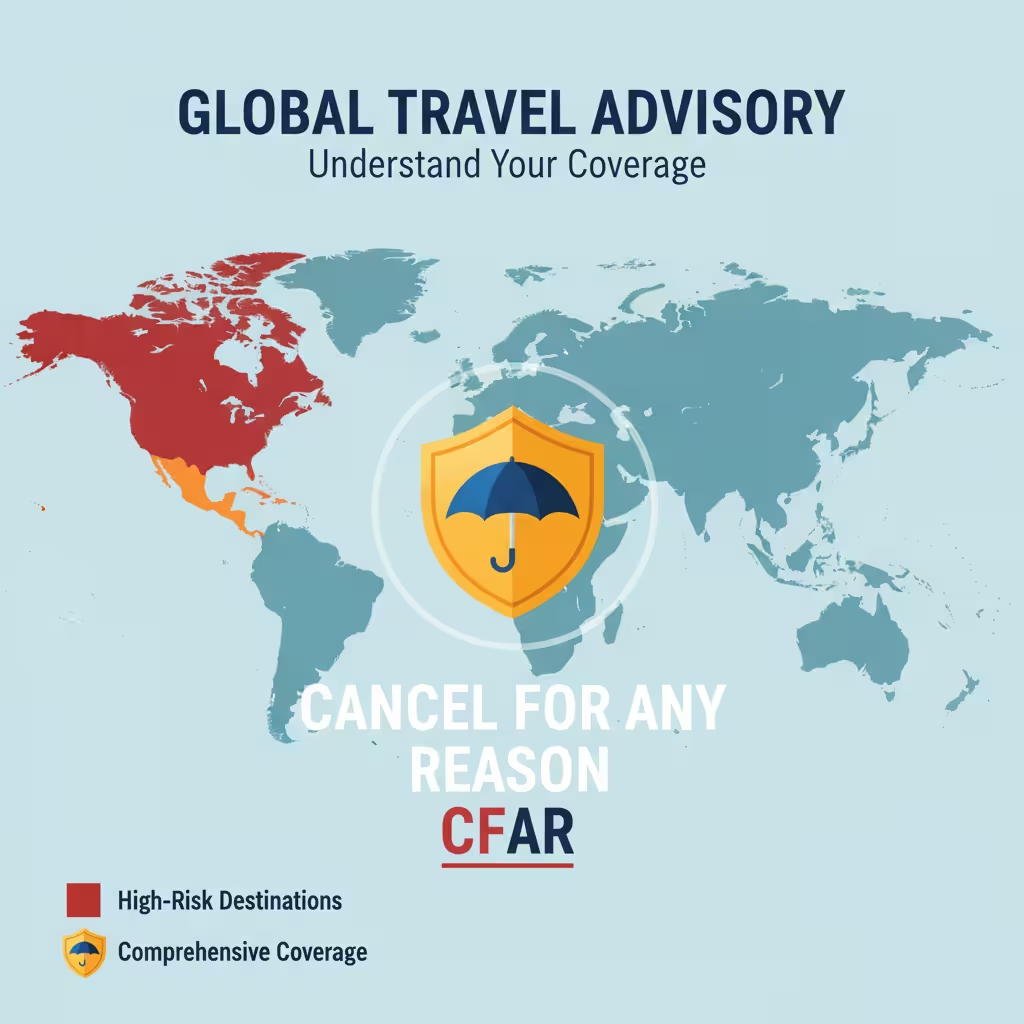
Where you’re going matters too. Canada is essentially the baseline. Western Europe adds a little. But destinations like India, Brazil, and Morocco push premiums up by 37% to 45% compared to that baseline — because medical evacuations in those regions can run $200,000 or more without coverage. CFAR layered onto a high-risk destination policy isn’t cheap.
When CFAR Is Genuinely Worth Every Dollar
There are situations where buying CFAR isn’t a luxury. It’s just smart.
Geopolitical uncertainty is the big one. Standard policies almost always exclude losses tied to acts of war, terrorism, or civil unrest. FAA airspace restrictions over Venezuela. Travel warnings for parts of Mexico. Situations where you technically can fly but don’t feel safe doing it. Standard insurance won’t help. CFAR will.
Government shutdowns are a newer wrinkle. In early 2026, a potential U.S. government shutdown had travelers genuinely worried about TSA staffing and FAA operations. Here’s the uncomfortable truth: standard travel insurance typically excludes losses caused by government closures. If flights get delayed or TSA lines become a nightmare because of a shutdown, you’re on your own under a regular policy.
CFAR — along with its trip-is-already-started cousin, IFAR (Interruption For Any Reason) — is one of the only products that actually covers you in those scenarios. If domestic political instability is a real concern when you’re booking, CFAR stops being an “upsell” and starts being basic protection.
High-dollar, non-refundable trips. A $12,000 family cruise with a strict no-refund policy and CFAR is a very different financial situation than the same cruise without it. The math tips quickly when the stakes are high.
Personal uncertainty. Job in flux. Aging parent whose health is “fine but.” A relationship that’s on wobbly ground. CFAR doesn’t require your life to be a disaster to use it — it just requires you to cancel 48 hours out and have a reason, any reason, that feels valid to you.
When CFAR Is Probably Not Worth It
Be honest with yourself here.
If you booked a domestic trip with mostly refundable hotels and a changeable airline ticket, CFAR is probably overkill. The changeable flight fee and a one-night hotel penalty hurt less than paying 40% more for your premium.
If you’re reading this and your trip is less than two weeks away, I’ve got bad news: you’ve already missed the CFAR purchase window. It’s a moot point now.
And if budget is genuinely tight and the premium difference is meaningful money to you, a strong base policy with solid medical limits — especially if you’re heading somewhere with limited hospitals — might protect you better per dollar than CFAR would.
How to Actually Get CFAR Coverage
The process isn’t complicated. The timing is everything.
Move fast after your first payment. The second you put any money down on this trip — a flight, a hotel, a tour — your CFAR window opens. Don’t wait a week to shop for insurance. Don’t put it on the to-do list. Buy within 14 days to keep your options open across all providers.
Add up every non-refundable dollar first. Before you go to any insurer’s website, know your number. Total it up: flights, hotels, excursions, cruise deposits, anything prepaid and locked in. That’s what you’ll insure.
Choose a policy that actually offers CFAR. Not all do. You’re looking for providers that list it explicitly as an optional add-on during checkout.
Add CFAR when you buy the base policy. You can’t go back and add it later. It’s a one-shot decision at the point of purchase.
One more thing: CFAR can’t be bought as a standalone product. It doesn’t exist on its own. You need a base travel insurance policy first, and then you add CFAR to it.

Which Providers Offer Strong CFAR Options?
Based on where things stood as of early 2026, here’s what the field looks like:
AIG Travel Guard is a solid all-around pick for travelers who want add-on flexibility — including pet travel and wedding coverage alongside CFAR. Their luggage tracking tools are genuinely useful for anxious packers.
Allianz Travel leans into annual plans, which can work out well for people who travel four or more times a year. Their TravelSmart App handles mobile claims cleanly.
Seven Corners is the go-to for large groups — parties of ten or more — and offers medical limits up to $500,000. If your trip involves remote terrain or a crew of people, this one earns its keep.
World Nomads covers more than 150 adventure sports. Skiing, scuba diving, rock climbing, bungee jumping — activities most standard policies quietly exclude. And unlike most providers, they let you buy or extend coverage after your trip has already started. That’s genuinely rare.
Travelex is the family play. Children 17 and under ride free on their major plans, which means a family of four doesn’t pay four adult premiums.
Nationwide built their cruise plans specifically for sea-based risks: shipboard service disruptions, missed ports, weather delays at sea. For big-ticket cruises with zero refund policies, their tiered plans pair well with CFAR.
HTH Travel Insurance specializes in long-term travelers — expats, students studying abroad, anyone spending months outside the U.S. Their Passport App helps you find qualified doctors internationally and translates medical terms when you’re in a country where you don’t speak the language.

CFAR and IFAR: Know the Difference
CFAR handles the “before” scenario. You haven’t left yet, you’ve decided not to go, and you want your money back.
IFAR — Interruption For Any Reason — handles the “during” scenario. You’re already on the trip. Something comes up. You need to cut it short and come home early. IFAR reimburses the unused portion of your trip costs.
Both products cover what standard insurance deliberately excludes: your personal decisions, government disruptions, and situations that don’t fit a pre-approved list.
If you’re heading somewhere with genuine uncertainty — political, meteorological, personal — buying both CFAR and IFAR together gives you protection from departure through return. That combo is about as covered as you can get.
The Bigger Picture (Because the Market Has Shifted)
Travel in 2025 and 2026 isn’t what it looked like two or three years ago.
That post-COVID “book everything and ask questions later” energy has cooled. Travelers are smarter now, or at least more cautious. Medical coverage adoption hit 80.8% in 2025 — up from 73.5% the year before. That’s 8 in 10 travelers actively choosing health protection before they board. The era of “I’ll be fine” is quietly ending.
And among travelers pulling in $200,000 or more per year, negative financial sentiment jumped from 9% to 15% in a single year. Even people with real money are pulling back, cutting trips, being choosier. CFAR fits that psychology perfectly. It’s not about being pessimistic. It’s about making a $10,000 commitment without feeling locked into it.
The bundle that grew the fastest in 2025 — Travel Medical plus Trip Interruption plus Trip Delay plus Baggage Protection — saw 369% growth. Travelers aren’t buying less coverage. They’re buying smarter coverage. CFAR is the next layer up from that.
Frequently Asked Questions – FAQ’s
- What is Cancel For Any Reason (CFAR) travel insurance?
CFAR is an optional add-on to standard travel insurance that lets you cancel your trip for any reason and receive partial reimbursement. - How much does CFAR travel insurance cost?
CFAR typically adds 40%-60% to your base travel insurance premium, depending on your trip cost and age. - What percentage of trip costs does CFAR reimburse?
CFAR reimburses 50%-75% of your non-refundable, prepaid trip costs, depending on the policy. - When should I buy CFAR travel insurance?
You must purchase CFAR within 10-21 days of your first trip deposit to qualify. - Does CFAR cover last-minute cancellations?
No, CFAR requires cancellations at least 48 hours before your scheduled departure. - Can I buy CFAR as a standalone policy?
No, CFAR is only available as an add-on to a standard travel insurance policy. - What are the main benefits of CFAR travel insurance?
CFAR provides flexibility to cancel for any reason, offering peace of mind and partial reimbursement. - Does CFAR cover COVID-19-related cancellations?
Yes, CFAR covers cancellations due to COVID-19, unlike standard policies with limited coverage. - Is CFAR worth it for domestic trips?
CFAR is usually more beneficial for high-cost, non-refundable international trips or uncertain travel plans. - Which providers offer CFAR travel insurance?
Providers like AIG Travel Guard, Allianz, and Seven Corners offer CFAR as an optional add-on.
The Short Answer
Is cancel for any reason travel insurance worth it?
For a lot of trips, yes. Especially big ones. Especially risky destinations. Especially when your personal life has any degree of unpredictability baked in.
But it has to be bought fast — within days of your first deposit — and it has to cover your full non-refundable costs. Those two rules are non-negotiable.
Miss them, and CFAR becomes just another thing you wish you’d done differently.
Get it right, and you’ve got something most travelers never have: a real exit. No questions, no documentation, no arguing with an adjuster. Just a cancellation and a check for most of what you lost.
That’s worth something. In most years, it’s worth a lot.
Important note: Coverage terms, reimbursement rates, and eligibility requirements vary by insurer and by state. Always read the full policy before you buy. If your trip is complicated or high-value, talking to a licensed travel insurance agent is worth the time.