

Meet Jake. He’s the type of guy who color-codes his vacation calendar, keeps receipts in an organized folder, and has a running list of dream destinations pinned to his fridge. In 2026, Jake finally decided to cash in his saved-up vacation days for his first-ever trip to the Amalfi Coast. Between flights, boutique hotels overlooking the sea, and private pasta-making classes, his total nonrefundable expenses climbed to $8,600.
Jake has always believed in planning for the unexpected. That’s why he bought standard travel insurance—and even considered options like cancel for any reason coverage—to back up his bookings. But when his beloved golden retriever, Max, started limping badly a few days before departure, his plans suddenly unraveled. His vet advised urgent surgery—Jake couldn’t leave Max alone. He called his travel insurance company, hoping for compassion and a quick approval.
Jake had standard trip cancellation, which only pays for a narrow set of approved reasons. For a full explanation of how trip cancellation insurance works and the other coverage types, see our complete guide
Instead, he got a polite, “Sorry, pet injuries don’t qualify under your policy.” Not only did Jake have to cancel his lifelong dream trip, but he was staring at an $8,600 loss he could not recover. Travelers with significant non-refundable international bookings have the most to gain from CFAR. See which international travel insurance plans with flexible cancellation options include CFAR as an add-on with competitive rates. Like thousands of travelers each year, Jake learned too late that standard travel insurance has strict rules about what counts as a “covered reason” for cancellation. This is where Cancel For any Reason Coverage (CFAR) comes in.
Let’s step into Jake’s shoes (and maybe save yourself from heartbreak) by understanding how CFAR works, whether it’s worth the extra cost, and when it truly pays off.
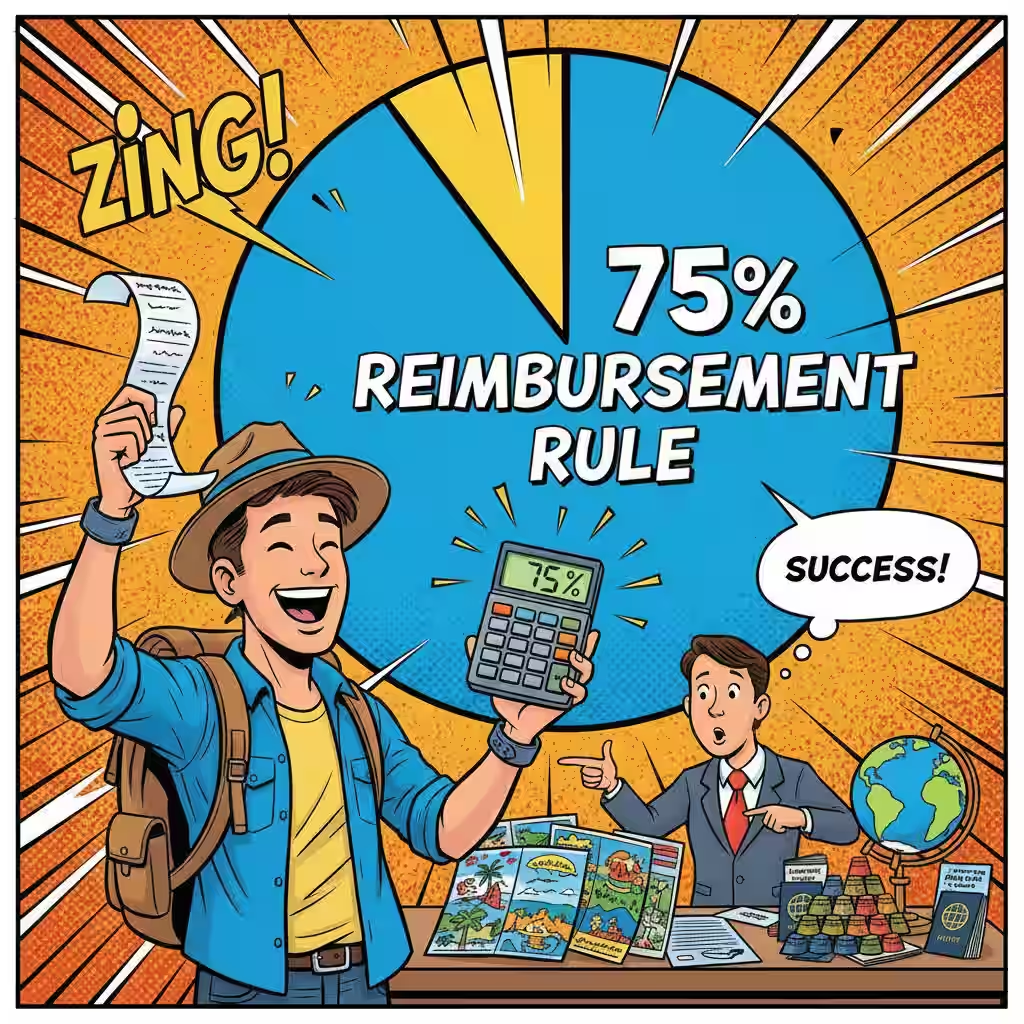
1. What CFAR Actually Covers: The 75% Rule
With the heartbreak Jake canceled the trip and a nonrefundable bill hanging over his head, he wondered: could I have done more? In his research, he kept coming across CFAR. This special add-on to travel insurance lets you cancel your trip for almost any reason—even if your reason is simply, “I changed my mind.”
For a detailed breakdown of the three purchase rules, the 48-hour cancellation window, and which plans offer CFAR travel insurance: rules, reimbursement rates, and top plans, see our full CFAR explainer
According to the U.S. Travel Insurance Association, only about 12% of travelers purchase CFAR despite it being available on most premium plans.
But, as Jake learned, there’s a catch: CFAR does not refund your entire trip. The industry standard for the reimbursement percentage in travel insurance with CFAR is 50%–75%. In 2026, most reputable policies offer 75% reimbursement of your nonrefundable expenses.
For Jake’s $8,600 Amalfi Coast adventure, this means that with CFAR he could have reclaimed $6,450 back—enough to take the sting out of an unexpectedly canceled trip. But here’s another CFAR reality: this refund only applies to what you lose and can’t get elsewhere. If his airline provided a $1,000 flight credit, only his remaining nonrefundable amount would be covered.
Important:
- Most CFAR policies must be bought within 10–21 days of your first payment for the trip.
- You can’t cancel at the very last minute. Nearly all plans have a pre-departure cancellation deadline: usually, you must cancel at least 48 hours before your scheduled departure.
Table 1: Reimbursement Comparison
| Scenario | Standard Insurance | CFAR (75%) |
| Trip canceled for a covered reason | 100% refund | 100% refund |
| Trip canceled for any other reason | $0 | Up to 75% refund |

2. Standard Trip Cancellation vs. CFAR: The “8 Covered Reasons” Dilemma
This is the core question behind every cancel for any reason vs trip cancellation insurance debate: what does standard coverage actually handle, and where does it leave you completely exposed?
Standard trip cancellation insurance covers a defined list of covered reasons — specific, documented events that the insurer pre-approves. These are solid protections for genuine emergencies.
CFAR covers everything standard does, plus anything the standard list misses. Jake’s mistake was assuming that “I need to attend to my dog’s emergency” qualified for coverage. But traditional plans have a strict list of trip cancellation covered reasons:
- Death of an immediate family member
- Serious illness or injury (needs a doctor’s note)
- Natural disaster at destination
- Home destroyed (fire, flood, or major damage)
- Jury duty/court order summons
- Documented terrorist incident at destination
- Unexpected job loss (usually if employed 1+ years)
- Travel supplier bankruptcy
With standard insurance, if your cancellation doesn’t fit exactly into one of these boxes, tough luck. Jake’s story, sadly, is typical.
Now imagine if he had CFAR. All he would need is to regret his trip and cancel 48 hours in advance—no doctor’s note, police report, or explanation necessary. He’d lose 25% of his costs but save the vast majority of his money.
Difference at a glance:
- Standard Travel Insurance: Offers 100% reimbursement but only for the strict, covered reasons above.
- CFAR: Offers up to 75% reimbursement for any reason, no questions asked, but costs more and refunds less.
The data backs this up. A 2025 survey by Squaremouth (one of the largest travel insurance comparison platforms in the U.S.) found that work-related reasons and personal/unspecified reasons accounted for 38% of CFAR claims — categories that would have been completely denied under standard trip cancellation coverage.
Source: Squaremouth Travel Insurance Survey 2025 | *Percentages based on CFAR-specific claim filings

3. Break-even Math: When CFAR Pays For Itself
Here’s where Jake pulled out his calculator (and maybe you should too!). Let’s break it down using his scenario—and a few more:
Jake’s Amalfi Trip Example
- Total trip cost: $8,600 (nonrefundable)
- Standard insurance premium: $340
- CFAR upgrade cost: $520 (a 53% increase)
- Total premium with CFAR: $860
- No coverage for his real-world reason: Loses $8,600 with standard, recovers $6,450 with CFAR
- CFAR puts $6,450 back in his pocket for $520 extra
Now, let’s try another scenario. Let’s say you plan:
- Budget trip costing $1,500
- Standard premium: $60
- CFAR upgrade: $30
- You pay $90 for coverage
- If you cancel and claim CFAR, you get $1,125 back
- But if you feel okay losing $1,500, the extra cost might not be worth it
Table 2: CFAR Break-even Examples
| Trip Cost | Standard Premium | CFAR Premium | Loss Without CFAR | Refund With CFAR (75%) | Net Savings |
| $10,000 | $400 | $600 | $10,000 | $7,500 | $6,900 |
| $5,000 | $200 | $120 | $5,000 | $3,750 | $3,630 |
| $1,500 | $60 | $30 | $1,500 | $1,125 | $1,065 |
Elaborating:
CFAR tends to pay off best with big-ticket, nonrefundable vacations or if you have a lifestyle that makes unexpected cancellations likely. Losing $7,500 is a gut punch, but not as bad as losing $10,000; for a few hundred dollars more, you buy yourself flexibility and sanity.

4. 2026 CFAR Provider Comparison: Who’s the Best?
When Jake started looking into a possible rebook of his Amalfi Coast dream, he dove deep into research on 2026 CFAR options. Each provider had slightly different purchase and cancellation deadlines, reimbursement percentages, and premium surcharges. This is a side-by-side look at what Jake found:
| Provider | Reimbursement % | Purchase Deadline | Cancellation Deadline | Avg. Cost Increase |
| TravelSafe | Up to 75% | Within 21 days | 48 hrs before trip | 50% |
| Seven Corners | Up to 75% | Within 20 days | 48 hrs before trip | 45% |
| John Hancock | Up to 75% | Within 14 days | 48 hrs before trip | 50% |
| Allianz | Up to 80% (select plans) | Within 14 days | 48 hrs before trip | 60% |
| Travelex | Up to 50% | Within 15 days | 48 hrs before trip | 40% |
Always double-check your plan: coverage, deadlines, and refund percentages differ by state and fine print!
**Visual:**Jake created a spreadsheet comparing his “Top 5 Best CFAR Travel Insurance 2026” providers and carefully marked the key deadlines on his calendar before booking his next adventure.

5. Who Should Always Buy CFAR?
CFAR isn’t overkill for everyone. In fact, for people like Jake, it’s a lifeline. Consider buying CFAR if you:
- Spend $5,000+ on a nonrefundable trip (safaris, resorts, multistop tours)
- Lead a busy or unpredictable life: small kids, caring for aging parents, or your career can change at a moment’s notice
- Travel in large groups: The more people, the more unpredictable!
- Suffer from travel anxiety and need the comfort of an easy exit, just in case
Seniors with pre-existing conditions often combine CFAR with a pre-existing condition waiver for maximum protection. See how senior travel insurance with cancellation flexibility handles both needs together.
Jake’s Next Trip
After Max recovered, Jake decided to plan a yoga retreat in Bali for some well-deserved relaxation. This time, he didn’t take any chances—he made sure to upgrade his policy with CFAR coverage. Sure enough, when a sudden family emergency popped up, Jake had to cancel just days before departure. He filed his claim ahead of the 48-hour cutoff and quickly got 75% of his $6,000 trip cost refunded, turning what could have been another financial disaster into a manageable setback—thanks to CFAR.
6. Who Should Skip CFAR—and Why
CFAR isn’t a must for everyone. Save yourself the upgrade if:
- Your trip is refundable: Hotels with flexible cancellation, airline credit options, etc., mean you’re already protected
- You’re on a tight budget: Backpackers and hostel-hoppers may find the upgrade cost outweighs the benefit
- You missed the purchase window: If you didn’t add CFAR 10–21 days after your first payment, it’s off the table
CFAR is for the rare (but real) situations whose reason to cancel is personal, not catastrophic—or simply hard to explain. For many budget travelers, standard insurance is “good enough”.
Jake’s Lessons Learned—and Yours
Looking back, Jake realized that every big trip comes with risks. “If I’d known about CFAR,” he says now, “I wouldn’t have lost thousands or been so stressed about what-ifs. It’s not for every getaway…but for anything big and nonrefundable, I’m never skipping it again.”
People Also Ask – PAA’s
Q1: Cancel for any reason travel insurance 75 percent reimbursement: How does it work?
If Jake’s nonrefundable trip cost is $4,000, a policy with a 75% reimbursement offers up to $3,000 back. All he would need is to cancel at least 48 hours before his trip, file the claim, and collect his payout—no tedious paperwork, explanations, or doctor’s notes.
Q2: Is cancellation for any reason travel insurance worth the extra cost?
Absolutely—if your nonrefundable trip expenses are higher than $3,000 and your life is unpredictable. Jake proved it: losing $2,000 is better than losing $8,000. But if you’re going on a cheap, refundable weekend escape, skip it.
Q3: How much more does cancellation for any reason insurance cost?
CFAR costs on average 40–60% more than standard coverage. If a basic plan is $100, adding CFAR bumps it to $140–$160, depending on company and coverage.
Q4: Cancel for any reason travel insurance deadline to purchase: When is it?
Jake learned this the hard way: CFAR must be bought soon after your first trip payment—in most cases, 10 to 21 days. If you miss that window, you’re out of luck.
Q5: Does credit card travel insurance include cancel for any reason?
Unfortunately, no. Even premium credit cards require a “covered reason” and proof for their trip cancellation insurance. You’ll need to purchase a separate policy for true CFAR protection.
Visual Summary: Quick Comparison Table
| Feature | Standard Trip Cancellation | Cancel For Any Reason (CFAR) |
| Covered Reasons | Limited (see above) | Any reason |
| Reimbursement Percentage | Up to 100% | Usually 50–75% |
| Documentation Needed | Yes | No |
| Upgrade Cost | Base price | +40% to +60% |
| Purchase Deadline | Up to final payment date | Within 10–21 days of deposit |
| Pre-departure Cancellation Time | Varies | 48+ hours before departure |
| Availability on Credit Cards | Yes, limited | No |
Final Thoughts: Is CFAR the Safety Net for Your 2026 Adventure?
Jake’s journey from heartbreak to travel happiness is both a warning and a lesson: never assume that careful planning alone will keep you protected. Cancel For any Reason Coverage fills the gap between life’s unpredictability and the rigidity of standard insurance policies.
If your next adventure is expensive, nonrefundable, or your life is full of wild cards—CFAR is not just a travel add-on but a real safety net. Add up your nonrefundable trip costs, consider your risk tolerance, and decide if the slightly high premium is a fair trade for total peace of mind.
Just remember Jake—and his loyal dog Max. Even the best-prepared trips can take an unexpected turn. With CFAR, the next surprise in your story doesn’t have to end in disaster.
Safe travels—and may your backup plans always be as strong as your sense of adventure!