

Last Updated: April 2026

Disclosure: Some links in this post connect to carriers or brokers that pay a referral fee. Doesn’t change what I say.
Robert got his first decline letter on a Tuesday. He was 58, Type 2 diabetic, managed with metformin, A1C sitting at 6.8 for two straight years. The agent he’d called told him, basically, “with diabetes it’s going to be tough.” He tried another carrier six months later. Another decline.
What nobody told Robert — not the first agent, not the second — was that an A1C below 7.0 with no complications is exactly what underwriters want to see. It’s the threshold that separates a Table Rating from a Standard approval at many carriers. He was sitting right on the good side of that line, and he’d been told twice he couldn’t get covered.
Third time, he found an independent broker who shopped his file across 22 carriers. Approved in nine days. Standard rates. $300,000, 20-year term, $143 a month.
Two declines. One broker change. That’s the whole story.
If you’re still figuring out which type of policy fits your situation, our complete life insurance guide explains every option — term, whole, and permanent — alongside what different health ratings actually cost.
Life insurance with pre-existing conditions isn’t the closed door most people think it is. It’s a door that opens differently depending on what you have, how well it’s managed, and — critically — who you ask.

The Industry Is Bigger Than It’s Ever Been. Sick People Are Still Getting Left Out.
The life insurance market hit $17.5 billion in new annualized premiums in 2025. That’s a record — the fourth one in five years. Individual policy sales grew 7% year over year. Indexed Universal Life alone pulled in $4.5 billion. Whole Life grew 7%, largely on the back of final expense products for middle-market buyers.
So the industry is flush. Growing fast. And yet 40% of American adults say they need more coverage than they have.
A huge chunk of that 40% has a health condition. They’ve been quoted too-high rates, hit with automatic declines, or never bothered applying because they assumed the answer would be no.
That assumption costs families real money. Not just in premiums — in protection they never got.
Here’s what the industry doesn’t advertise: underwriting in 2026 is more condition-specific and data-driven than ever before. Carriers aren’t applying blanket exclusions anymore. They’re running prescription databases, reviewing clinical markers, checking MIB records. An applicant with well-controlled diabetes isn’t in the same risk pool as someone with unmanaged, complicated diabetes. The pricing reflects that. The approval odds reflect that. Most applicants just never find out.

How Underwriters Actually See Your Health
This is the piece most people never get explained to them.
Underwriters don’t think in diagnoses. They think in transition rates — the actuarial term for how likely you are to move from “Healthy” to “Disabled” to “Dead” over the life of the policy. A diagnosis is just the starting point. What actually drives the rating is how stable the condition is, how well it’s controlled, and whether complications have developed.
The formal classification system runs from Super Preferred at the top — excellent health, clean family history, ideal BMI — down through Preferred, Standard Plus, Standard, and then into what’s called Table Ratings.
Table Ratings are where substandard risk applicants land. Each table adds roughly 25% to the standard premium rate. Table 2 is a 50% surcharge above standard. Table 4 is a 100% surcharge. Table 8 is 200%. It goes up to Table 16. So yes, someone with a complex health history will pay more — but that doesn’t mean they can’t get covered. Rated policies are real policies. They pay out. They protect families.
The gap between “I have this condition” and “I know which table I’d land on and what that costs per month” is where most people get lost. Agents who don’t specialize in high risk life insurance often default to the easy decline rather than doing the work to find the right carrier. Our review of the best life insurance companies for high-risk applicants identifies which carriers — like Guardian — are most lenient on health history.

Can You Get Life Insurance If You Have Type 2 Diabetes?
Yes. And often at better rates than people expect.
Can you get life insurance if you have diabetes type 2 is one of the most searched insurance questions in America — and the answer is almost always yes, with caveats that matter enormously.
The key number is A1C. An A1C below 7.0 with no organ complications — no retinopathy, no nephropathy, no neuropathy — puts a Type 2 diabetic in contention for Standard rates at multiple carriers. That’s not a special deal. That’s how the actuarial math works when the condition is managed.
A1C between 7.0 and 9.0 typically results in a Table Rating — usually Table 2 to Table 4, meaning the premium runs 50%–100% above standard. Still insurable. More expensive, but insurable.
A1C above 9.0, or any A1C with documented kidney or eye complications? That’s when declines start appearing, or when coverage gets pushed to Simplified Issue or Guaranteed Issue products with smaller face amounts. We cover all three types of no-exam life insurance options — accelerated underwriting, simplified issue, and guaranteed acceptance — in detail, including which health profiles qualify for each.
Life insurance for diabetics is one of the areas where working with an independent broker — someone who places business across 20-plus carriers rather than pushing one company’s products — makes the biggest difference. Different carriers have different “niches” for diabetic applicants. Some are more lenient on onset age. Some weight recent A1C improvement more heavily. Shopping the file matters.

Life Insurance After a Heart Attack — Is It Possible?
Harder. But not impossible.
The first thing any underwriter wants to know after a cardiac event: how much time has passed? Most carriers require a minimum of 12 to 24 months post-myocardial infarction before they’ll consider an application at all. Apply before that window closes and you’ll likely get declined — not because you’re uninsurable forever, but because the risk picture isn’t stable enough yet to price accurately.
After that waiting period, two clinical markers drive the rating more than anything else.
Ejection fraction — the measure of how efficiently the heart pumps blood — is the big one. A normal ejection fraction runs 55% to 70%. The closer to that range, the better the rating. An EF below 40% is a serious red flag for most carriers.
The second is medication count. Multiple cardiac medications signal ongoing management needs, which actuaries translate into higher transition rates toward disability or death. That’s not a moral judgment — it’s probability math.
Life insurance after heart attack — is it possible? Post-MI applicants with good ejection fractions, stable readings for 18-plus months, and well-managed cholesterol and blood pressure can often land in the Table 6 range. More expensive than standard, but real coverage with real death benefits. Some carriers have specific programs for this exact profile.
The honest answer to avoid here is any carrier that fast-tracks without reviewing the full cardiac history. Those are often Simplified Issue products with $25,000 benefit caps. Fine for final expense planning. Not adequate for income replacement.

Cancer History and Life Insurance: The Timeline Matters More Than the Diagnosis
Life insurance with cancer history is one of the most variable categories in underwriting — because cancer isn’t one thing. The type, the stage, and the years in remission are the three levers that determine everything.
Here’s a rough map of how carriers typically look at this:
Basal cell skin cancer is often rated no differently than someone without cancer, even shortly after treatment. It’s the one cancer that frequently reaches Preferred rates within a year or two.
Breast cancer, colon cancer, thyroid cancer — typically require two to five years in complete remission before Standard rates become available, depending on the stage at diagnosis.
Stage III or Stage IV cancers — most carriers want to see ten or more years of clean remission before considering Standard rates. Some carriers won’t consider an application until that ten-year mark regardless of the specific diagnosis.
The best life insurance for cancer survivors 2026 isn’t a single company — it’s the carrier whose niche matches the specific cancer type and remission timeline. This is another situation where an independent broker with experience in impaired-risk cases makes a concrete dollar difference. Two carriers might quote the same applicant at Table 4 and Preferred Plus respectively, based on how they weight that particular cancer history.

High Blood Pressure and Life Insurance Approval
High blood pressure life insurance approval odds are genuinely good — when the condition is controlled.
Mild, well-managed hypertension with a stable medication regimen typically lands an applicant at Preferred rates. Not Preferred Plus, but Preferred — a 15% to 20% premium bump above baseline, which for most people translates to a small monthly difference.
Uncontrolled hypertension — readings consistently above 160/100 despite medication — is a different situation. That profile often pushes into Standard or Table Rating territory, and triggers full underwriting regardless of the applicant’s other health metrics.
The clinical marker underwriters watch alongside blood pressure: cholesterol and BMI. Hypertension alone is manageable. Hypertension with elevated LDL and obesity together? That’s where the table numbers start climbing.
One tip that’s worth knowing and almost never gets mentioned in generic insurance articles: if you’ve recently improved your blood pressure readings through medication adjustment or lifestyle changes, document it. Three to six months of better readings, captured in medical records, can materially shift a rating. Underwriters are allowed to reconsider. Ask your broker about requesting a rating reconsideration with updated clinical evidence.
When Standard Underwriting Is Off the Table: Simplified and Guaranteed Issue
For applicants with severe unmanaged conditions or multiple serious diagnoses, the traditional underwriting ladder may not be accessible. Two alternative products exist for exactly this situation.
Simplified Issue requires no medical exam but asks 5 to 15 health questions. Face amounts run from $25,000 to $500,000 depending on the carrier. Approval is faster — often within 48 hours. Premiums are higher per thousand dollars of coverage than a fully underwritten policy, but the product is legitimate and pays full benefits from day one in most cases.
Guaranteed Issue whole life asks nothing about your health. No questions, no exam, no records review. Acceptance is guaranteed within the eligible age range, typically 45 to 85. Coverage caps out at $25,000 in most cases. Every guaranteed issue policy includes a graded death benefit — if the insured dies from natural causes within the first two years, the beneficiary gets premiums paid plus interest, not the full face amount. After the two-year window closes, the full benefit pays.
Guaranteed issue is the right fit for one specific profile: someone with severe, uncontrolled, or multiple health conditions who genuinely can’t qualify for anything else, and whose primary goal is covering funeral and final expense costs. It’s not income replacement. It’s a floor.
One more option that most people overlook entirely: group life through an employer. Most employer group life policies issue base coverage — usually one to two times annual salary — without individual underwriting. If you have significant health conditions and your employer offers group life, that base coverage is often the cheapest and most accessible protection you can get, because you’re being pooled with the entire workforce rather than priced as an individual risk.
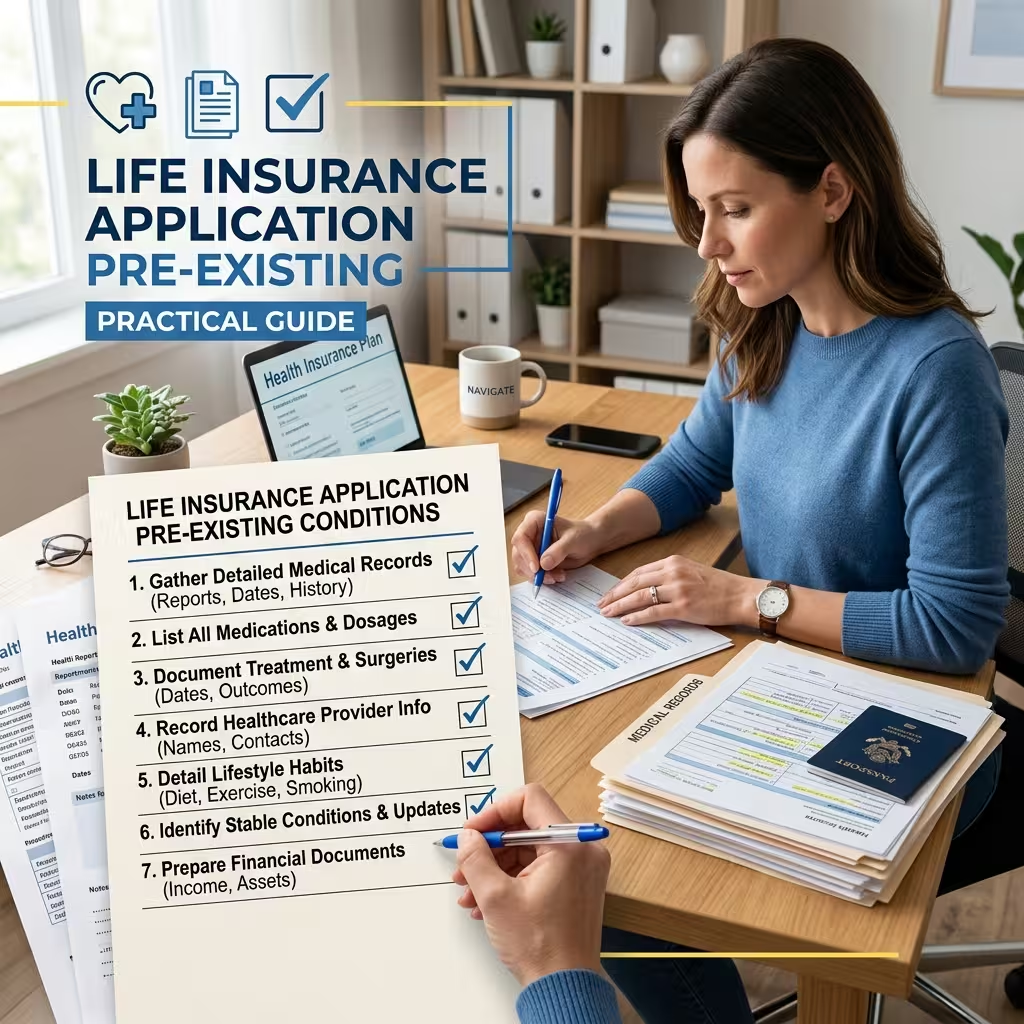
The Practical Checklist Before You Apply
These four steps make a measurable difference in approval odds and premium pricing.
Get your clinical markers on paper. A1C, blood pressure readings, ejection fraction if applicable, cholesterol panel. Three to six months of documented, stable, well-controlled numbers shift rating decisions. Underwriters fill gaps in medical data with worst-case assumptions. Don’t give them gaps.
Work with an independent broker, not a captive agent. A captive agent sells one company’s products. When your file doesn’t fit that company’s niche, you get a decline. An independent broker can shop your application across 20-plus carriers simultaneously, matching your specific condition profile to the carriers who specialize in it.
Disclose fully. This is counterintuitive for people worried about declines — but incomplete medical history doesn’t help. Underwriters will check prescription databases and MIB records. Missing information gets flagged, and a flagged application is treated as a higher risk than a complete one.
Apply early. Ratings are most favorable at younger ages, before chronic conditions typically compound. Every year of delay with a known condition means both higher age-based pricing and potentially more complex health history to underwrite. The best time to lock in coverage was five years ago. The second-best time is now.
People Also Ask – PAA’s
Can I get life insurance if I have Type 2 diabetes?
Yes. An A1C below 7.0 with no complications can qualify for Standard rates at multiple carriers. Work with an independent broker who specializes in diabetic applicants — carrier niches vary more than most people realize.
How long after a heart attack before I can apply for life insurance?
Most carriers require 12 to 24 months post-MI before reviewing an application. After that window, ejection fraction and medication stability are the primary rating factors.
What is a Table Rating and what does it cost?
A Table Rating is a substandard classification for applicants with elevated health risks. Each table adds roughly 25% to the standard premium. Table 4 means 100% above standard. It’s more expensive — but it’s real, full-benefit coverage.
Is guaranteed issue whole life worth it?
For applicants with severe health conditions who can’t qualify elsewhere, yes — but only for final expense purposes. The $25,000 coverage cap and graded death benefit make it unsuitable for income replacement. It’s a floor, not a full solution.
What conditions require full underwriting — no fast-track approval?
Atrial fibrillation, coronary artery disease, cancer (except basal cell), COPD, kidney disease, stroke history, bipolar disorder, and diabetes with complications all typically trigger full underwriting review. Automated systems can’t price these accurately enough.
Can I get a rating reconsidered if my health improves?
Yes. Three to six months of documented clinical improvement — lower A1C, better blood pressure readings, stable cardiac markers — is grounds to request a re-rating. Ask your broker to submit updated medical evidence with the reconsideration request.
Robert’s Policy Is Active
Standard rates. $300,000 in coverage. A beneficiary who doesn’t know yet how close that almost didn’t happen.
Two declines from agents who didn’t specialize in high risk life insurance. One independent broker who knew which carriers had a niche for well-managed Type 2 diabetics. Nine days from application to approval.
That’s the whole equation. Not luck. Not a special program. Just someone who knew where to shop.
If you have a health condition and haven’t applied — or got declined and stopped there — the 2026 market has more options, more data-driven underwriting, and more carriers with condition-specific programs than at any point in the industry’s history.
Get your clinical markers documented. Find an independent broker. Apply.
About the Author
Selene Voss is a financial writer and licensed insurance content consultant with 14 years covering life insurance underwriting, impaired-risk coverage, and consumer insurance research. Her analysis draws on LIMRA market data, Allianz underwriting frameworks, and actuarial fairness research. She does not sell insurance policies.
Disclaimer: This article is for informational purposes only and does not constitute financial, legal, or medical advice. Premium estimates and underwriting criteria reflect general 2026 market ranges and vary by carrier, state, and individual health profile. Always consult a licensed insurance professional before purchasing. Underwriting guidelines change — verify current criteria with your broker.