

Last Updated: April 2026

Kevin kept a sticky note on his fridge for two years. It said: Call about life insurance.
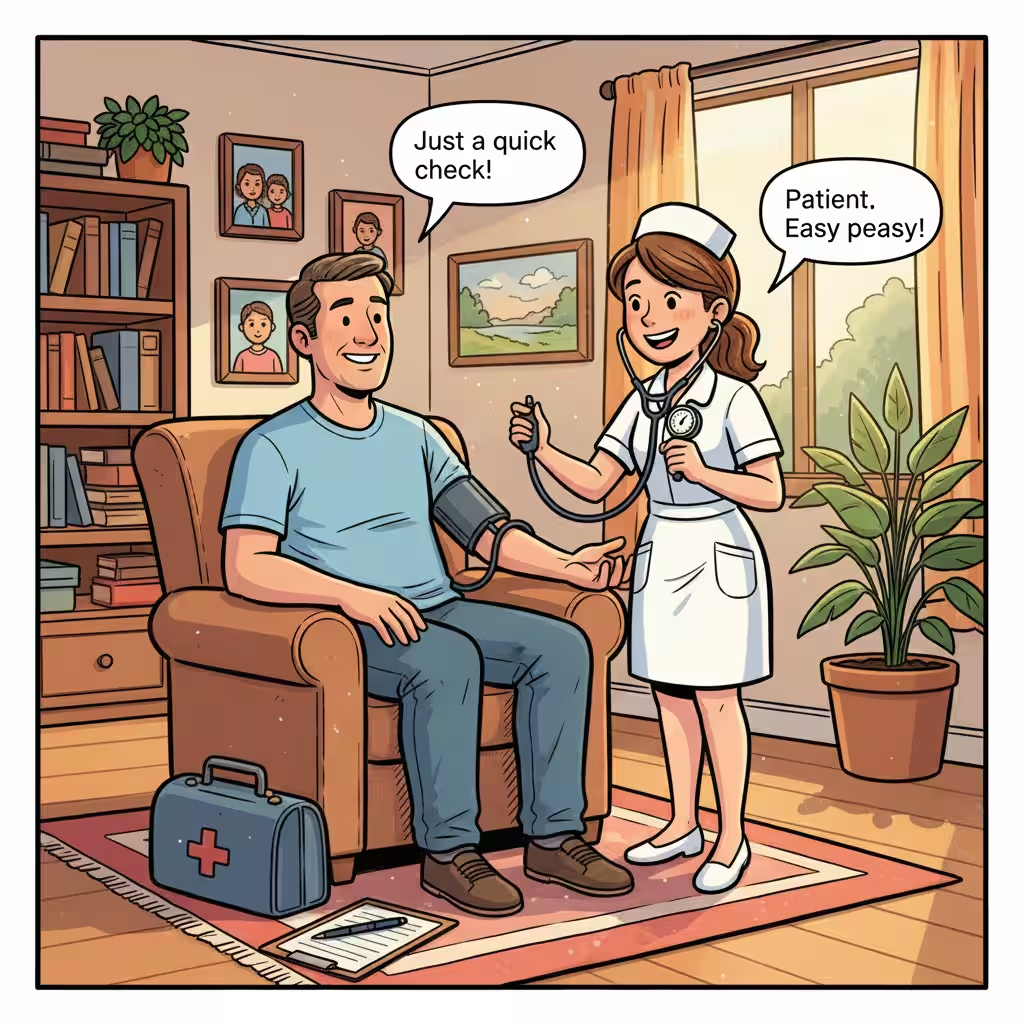
He’d look at it every morning. Every morning he’d think about the exam — the nurse visit, the blood draw, the urine sample, the weeks of waiting. He had high blood pressure. Nothing serious, nothing unmanaged, but enough that he assumed he’d get turned down anyway.
So he never called.
Then his buddy at work — same age, similar health history — mentioned he’d gotten covered in 15 minutes. Online. No exam. No nurse. No waiting.
Kevin applied that Tuesday. He was approved before dinner.
Here’s the thing: Kevin’s situation isn’t rare anymore. No exam life insurance has gone from a niche workaround to one of the most common ways Americans get covered in 2026. The technology driving it is better than most people realize. And the options — depending on your health and how much coverage you want — are wider than almost anyone expects.
This guide breaks all of it down. No fluff. Just what you need to know. New to life insurance entirely? Our full life insurance guide explains every policy type, cost factor, and top-rated carrier in one place.
Disclosure: Some carrier links in this article may be affiliate partnerships. We earn a small commission if you purchase through them — at no extra cost to you. It doesn’t change our recommendations.
Why the Medical Exam Is Disappearing
Not long ago, buying life insurance meant scheduling a paramedical exam. A nurse came to your house or office. Blood draw, blood pressure reading, urine sample, height and weight. Results went to the carrier. The carrier reviewed them. You waited. Sometimes weeks.
That process still exists. For large policies — we’re talking $3 million, $5 million and up — it still makes sense for carriers to run full exams.
But for the coverage amounts most families actually need? Carriers don’t need your blood anymore.
They have something better. Electronic health records, prescription databases, motor vehicle records, and algorithms that pull and analyze all of it in seconds. According to LIMRA, AI-powered accelerated underwriting has compressed what used to take weeks into decisions that come back in 24 to 48 hours — sometimes faster.
This isn’t a corner-cutting move by insurers. It’s a data upgrade. They’re getting more information than a one-time physical ever gave them, and they’re getting it faster. Which means approvals are faster too.

There Are Three Types of No-Exam Life Insurance — and They’re Not the Same
Here’s where most people go wrong. They search “no exam life insurance,” find three different products that all claim to skip the physical, and assume they’re basically identical.
They’re not.
Each one uses a different method to assess your risk. That affects your premium, your coverage limit, and whether you even qualify.
Accelerated Underwriting — The Full-Coverage Option
This is the gold standard. If you qualify, you get the same pricing as a fully underwritten policy — the same rates you’d get after a traditional exam — but without the exam.
How? The carrier pulls your electronic health records, prescription history, and motor vehicle record. An algorithm reviews everything. If your profile is clean enough, you’re approved. Fast.
Nationwide’s Life Essentials platform gives instant decisions for many applicants. Penn Mutual goes up to $10 million in coverage through this process for eligible applicants. Banner Life offers terms up to 40 years — one of the longest available anywhere.
Who it’s for: people in their 30s, 40s, or early 50s who are in reasonably good health and want $250,000 to $3 million in coverage without the hassle of scheduling a physical.
Who it’s NOT for: people with complicated health histories, recent hospitalizations, or multiple prescription medications. The algorithms are thorough. If something’s there, they’ll find it.
Simplified Issue — The Fast Middle Ground
No exam. But there’s a health questionnaire. Usually 10 to 15 questions.
The carrier verifies your answers against pharmacy databases and other records. It’s not invasive, but it’s not a rubber stamp either.
Coverage typically runs from $25,000 to $500,000. Premiums are a bit higher than accelerated underwriting because the carrier has slightly less data. That’s the trade-off for the looser health requirements.
This is the sweet spot for people who have one or two manageable health conditions — controlled diabetes, mild hypertension, a past health event that’s been stable for a few years. If you have a more complex health history, read our dedicated guide to life insurance with pre-existing conditions — it covers what underwriters actually look at and which carriers are most lenient. Not automatic disqualifiers, but enough to make full accelerated underwriting risky.
Transamerica accepts applicants up to age 80 through its simplified issue process and includes living benefit riders, which is a rare combination.

Guaranteed Acceptance Life Insurance — No Questions, No Exam, No Rejection
This one does exactly what it sounds like. You apply. You get accepted. Period.
No health questions. No prescription review. No medical history. If you’re within the eligible age range — usually 45 to 85 — you’re in.
The trade-offs are real and worth understanding before you sign anything.
Coverage caps are lower. Most guaranteed acceptance policies top out at $25,000 to $50,000. Premiums are higher relative to the death benefit because the carrier has zero information about your health. And — this part matters — almost every guaranteed acceptance policy has a two-year waiting period called a graded death benefit.
Here’s what that means. If you die of natural causes within the first two years of the policy, your family doesn’t receive the full benefit. They get back the premiums you paid, plus interest — usually 10% to 20% on top.
Accidental death? Covered at the full amount from day one.
After the two-year window closes, the full benefit applies to any cause of death. No exceptions.
This isn’t a trick buried in the fine print. It’s the mechanism that lets carriers say yes to everyone without any health information. The practical implication: don’t wait to apply. The two-year clock starts when you submit your application. Every month you delay is a month that clock hasn’t started.
Ethos runs a fully digital guaranteed acceptance process with a 94% approval rate. For seniors or anyone with serious health conditions who’ve been turned down elsewhere, this is often the only realistic path — and that’s not a consolation prize. It’s the right tool for the situation. We cover the full range of life insurance for seniors — including final expense, guaranteed issue, and whole life — in our dedicated guide for applicants over 60.

The Number People Get Wrong
42% of Americans think life insurance costs three to six times more than it actually does.
That’s not an opinion. LIMRA’s research documents it. People avoid even looking because they’ve already decided it’s unaffordable — before they’ve seen a single quote.
For a healthy 35-year-old, a $500,000 20-year term policy can run less than $25 a month.
No exam.
Now — for guaranteed acceptance policies, the math is different. You’re paying more per dollar of coverage because the carrier is taking on more unknown risk. But for the coverage amounts these policies provide — $10,000 to $25,000 — the monthly premium is often $50 to $100 for seniors in their 60s and 70s.
That’s manageable. For most people on fixed incomes trying to cover a funeral and small debts, it’s a reasonable number.
The people who never look are the ones who end up leaving their families with a $12,000 funeral bill and no plan.
How Much No-Exam Life Insurance Can You Actually Get?
This depends entirely on which category you’re applying through.
| Underwriting Type | Max Coverage (Typical) | Health Requirements | Decision Speed |
| Accelerated Underwriting | $3M – $10M | Good health, clean records | Minutes to 48 hours |
| Simplified Issue | $25K – $500K | Minor conditions OK | Same day to 1 week |
| Guaranteed Acceptance | $25K – $50K | None | Immediate |
If you want $500,000 or more in coverage without an exam, accelerated underwriting is your path. Your health profile has to support it — but if it does, you get full coverage at full-underwriting rates. No compromise.
If your health is more complicated, simplified issue gets you meaningful coverage fast. $250,000 is still $250,000.
If you’ve been declined elsewhere or have serious health conditions, guaranteed acceptance gives you something — and something is far better than nothing.

Top Providers Worth Looking at in 2026
Note: Some links below may be affiliate links. Our rankings reflect carrier performance data and consumer research — not commission rates.
Nationwide — Best overall for no-exam coverage. Their Life Essentials digital platform delivers instant decisions for many applicants. Coverage up to $1.5M–$5M depending on underwriting path. MoneyGeek score: 4.5/5.
Banner Life — Best for affordability and long terms. Offers terms up to 40 years — longer than any other major carrier. Coverage up to $4M through accelerated underwriting. Consistently the most affordable option for healthy applicants.
Transamerica — Best for seniors and applicants over 60. Accepts applications up to age 80. Includes living benefit riders on many policies — a feature most competitors charge extra for or don’t offer at all.
Penn Mutual — Best for high coverage without an exam. Up to $10 million for eligible applicants through accelerated underwriting. Not the place to start if your health history is messy, but unmatched for healthy applicants who want maximum coverage fast.
Pacific Life — Best for applicants who smoke or have complicated health histories. Uses a tiered system instead of hard declines — meaning more people get some coverage rather than a flat no. Leads J.D. Power satisfaction rankings with a score of 768.
Ethos — Best digital experience. 94% approval rate through an automated process. Fully online, no agent required. Good starting point for people who want to get a fast answer without a phone call.
One Thing Most People Don’t Know
Only 7% of consumers realize that buying life insurance entirely online — through simplified underwriting — can actually cost more than going through full underwriting.
Let that sit for a second.
The “fast and easy” version isn’t always cheaper. Carriers charge more when they know less about your health. If you’re healthy and you want the best rates, full accelerated underwriting — even online — will serve you better than simplified issue.
The trade-off is that accelerated underwriting has stricter health requirements. If you pass, you pay less. If you don’t, simplified issue is your next stop.
This is worth knowing before you apply. It changes how you shop.
People Also Ask – PAA’s
What is the best no medical exam life insurance in 2026?
For healthy applicants wanting maximum coverage, Nationwide and Penn Mutual lead on accelerated underwriting. For seniors or applicants with health complications, Transamerica and Ethos are consistently strong. The best choice depends on your age, health profile, and how much coverage you need.
Can I get life insurance without a blood test or physical?
Yes. Accelerated underwriting, simplified issue, and guaranteed acceptance policies all skip the physical exam and blood draw. Instead, carriers use electronic health records, prescription databases, and health questionnaires to assess risk — depending on which category you qualify for.
How much no-exam life insurance can I get?
Through accelerated underwriting, eligible applicants can get up to $10 million — Penn Mutual offers this for qualifying profiles. Simplified issue tops out around $500,000. Guaranteed acceptance policies typically cap at $25,000 to $50,000.
Is guaranteed acceptance life insurance worth it?
For people with serious health conditions who’ve been declined elsewhere, yes — it’s often the only path available. The premiums are higher and coverage is lower than other types, and there’s a two-year waiting period for natural cause deaths. But having $25,000 in coverage beats having nothing. Apply sooner rather than later so the waiting period starts.
Is online life insurance more expensive?
Sometimes. Simplified issue policies — which are common online — charge higher premiums because the carrier has less health information. If you’re in good health, going through full accelerated underwriting (even online) will usually get you better rates than simplified issue.
What health conditions disqualify me from no-exam life insurance?
Accelerated underwriting is stricter — active cancer treatment, recent major cardiac events, or multiple serious conditions can trigger a decline or push you to a traditional exam. Simplified issue accepts more conditions, including controlled diabetes and stable hypertension. Guaranteed acceptance has no health requirements at all.
Kevin’s sticky note is gone now. He threw it away the day his policy arrived.
$750,000 in term coverage. No exam. Approved the same afternoon he applied.
He told me later that the part that surprised him most wasn’t how fast it was. It was that he’d waited two years for a process that took 15 minutes.
His family is covered. His wife knows it. His kids don’t know it yet — but someday that piece of paper is going to matter enormously.
That’s what this is actually about. Not the technology. Not the algorithms or the carriers or the approval rates.
It’s about removing the last excuse between you and protecting the people who depend on you.
The exam isn’t the reason anymore. So what’s stopping you?
Disclaimer: This article is for informational purposes only and does not constitute financial, legal, or insurance advice. Premium estimates are 2026 market averages and vary by carrier, state, age, and individual underwriting. Always consult a licensed insurance professional before purchasing a policy.