
Nobody tells you the full list. That’s the real problem. You get the notice – court paperwork, DMV letter, whatever – and it says you need SR-22, and most people assume they know why. DUI, reckless driving. That’s the mental list. And then they start digging and realize the reasons for SR-22 requirement are genuinely stranger than that. Child support. Drug possession with no dangerous driving involved. A judge who felt like adding it on a case where the law didn’t even require it. Some of these aren’t even driving offenses. Worth knowing before you end up on the wrong end of one.
Quick Summary: What are the main reasons for an SR-22 requirement?
An SR-22 certificate is a financial responsibility form filed by your auto insurer to prove you carry the mandated liability coverage. The most common reasons you might be required to file an SR-22 include:
- DUI or DWI Convictions: The single most frequent trigger across all states.
- Major Driving Violations: This includes reckless driving, street racing, and hit-and-run incidents.
- Uninsured Driving: Getting caught operating a vehicle without insurance or causing an at-fault accident while uninsured.
- Administrative & Non-Driving Issues: License reinstatement conditions following consecutive point accumulation, severe unpaid traffic fines, or missed child support payments.

DUI is the big one – but how big, and does type matter?
Enormous. DUI is the single most common trigger and it’s not competitive. But people treat “DUI” as one uniform thing when the category has real variation underneath it.
First offense with no aggravating factors – most states attach SR-22 as a reinstatement condition automatically. Three years of continuous filing is standard. But “standard” moves if the circumstances were bad: high BAC, a child in the car, a crash while impaired. Those push the timeline.
Second or third offense? Virginia runs DUI penalties consecutively, not simultaneously. Two convictions plus a refusal charge don’t combine into a three-year period. They stack. End of first penalty, start of second. The SR-22 filing period follows that same math.
DWI – in most states – gets identical SR-22 treatment. Some states use DWI for higher BAC levels, others use DUI and DWI interchangeably. For filing purposes the terminology barely matters. Both get slotted as serious alcohol offense, same category, same requirement.
One thing worth flagging for people who move states mid-requirement: the SR-22 obligation belongs to the state that issued it. Relocate to a new state and the original state’s DMV still holds authority over your filing period until it’s complete. You need an insurer licensed in both states. The National Driver Register – a federal database covering all fifty states – is what makes this enforceable: a suspension in your original state flags nationally, and most other states won’t issue you an unrestricted license until you’ve cleared it.
FR- 44 – the version Virginia and Florida use for DUI
Virginia and Florida don’t use the standard SR-22 for DUI. They require an FR-44 certificate. Same filing mechanics – your insurer files it, it’s not an insurance product itself – but the coverage minimums required are significantly higher than standard SR-22 minimums.
Virginia FR-44: $50,000 per person bodily injury, $100,000 per accident, $40,000 property damage. Double the standard SR-22 minimums in that state. The premium jump you see reflects the gap in required coverage.
Non-DUI Driving Violations That Require an SR-22
More than most people track. DUI gets all the attention. These others come as surprises.
Reckless driving shows up constantly. People didn’t think their ticket qualified – and then they find out “reckless” is a legal term with a specific meaning, not a description of general aggression. Willful disregard for the safety of others or property. In Virginia, crossing 85 mph anywhere in the state – regardless of the posted limit – meets that legal definition automatically. Highway with an 80 mph limit, you’re doing 86, that’s reckless driving. SR-22 follows conviction in most states.
Hit-and-run. Leave a crash scene with injuries involved and you’re looking at a license suspension plus SR-22 as a reinstatement condition, standard. How long the requirement runs depends on crash severity.
Driving without insurance – people consistently underestimate what this triggers. Getting stopped without coverage: fine, points, move on. Causing an accident without coverage: that’s a different situation. SR-22 requirement plus an unsatisfied judgment that needs its own resolution. Two separate problems created at once.
At-fault accident while uninsured is a legally distinct offense from driving without coverage. Cause a wreck you can’t financially satisfy – no insurance, inadequate limits, whatever – and most states want SR-22 as proof you’re now carrying coverage. The underlying judgment from the crash remains a separate matter.
Street racing. Tennessee explicitly lists speed contest racing on public roads as an SR-22 trigger. Some other states do the same. It doesn’t get categorized as a minor infraction in the jurisdictions that specifically call it out.
Vehicular manslaughter. Where reinstatement is even possible after that conviction, SR-22 is the floor. Not the ceiling. The starting point.

Wait – can SR-22 get triggered by something that had nothing to do with driving?
This is the part most articles don’t mention, and it’s real.
Child support. Miss enough court-ordered child support payments and several states will suspend your license. When you eventually reinstate it, SR-22 can be a condition. Your actual driving record is irrelevant. The requirement attaches to the reinstatement itself, not to anything you did or didn’t do behind the wheel.
Sit with that one for a moment. Spotless driving record. Job loss. Missed support payments. License suspended administratively. Go to reinstate it – and there’s an SR-22 condition waiting. Some states treat SR-22 as standard for any prolonged license lapse during reinstatement, regardless of the original suspension reason. The logic is blunt: license was inactive, demonstrate you’re insurable, that’s the deal.
Unpaid fines and failure to appear. License suspended for not showing up to court or for letting traffic fines pile up – that’s administrative, not a driving behavior issue. But reinstatement in some states still carries SR-22. The DMV’s reasoning runs something like: license lapsed, coverage proof required before restoration, the cause of the lapse is not our primary concern.
Drug possession while driving. Tennessee mandates SR-22 for felony drug possession – specifically methamphetamine – when the offense happened while the person was operating a vehicle. The charge is possession. Driving behavior wasn’t the issue. SR-22 attaches anyway. Probably the clearest case of how states have pushed the SR-22 requirement into territory that has nothing to do with road safety in the traditional sense.
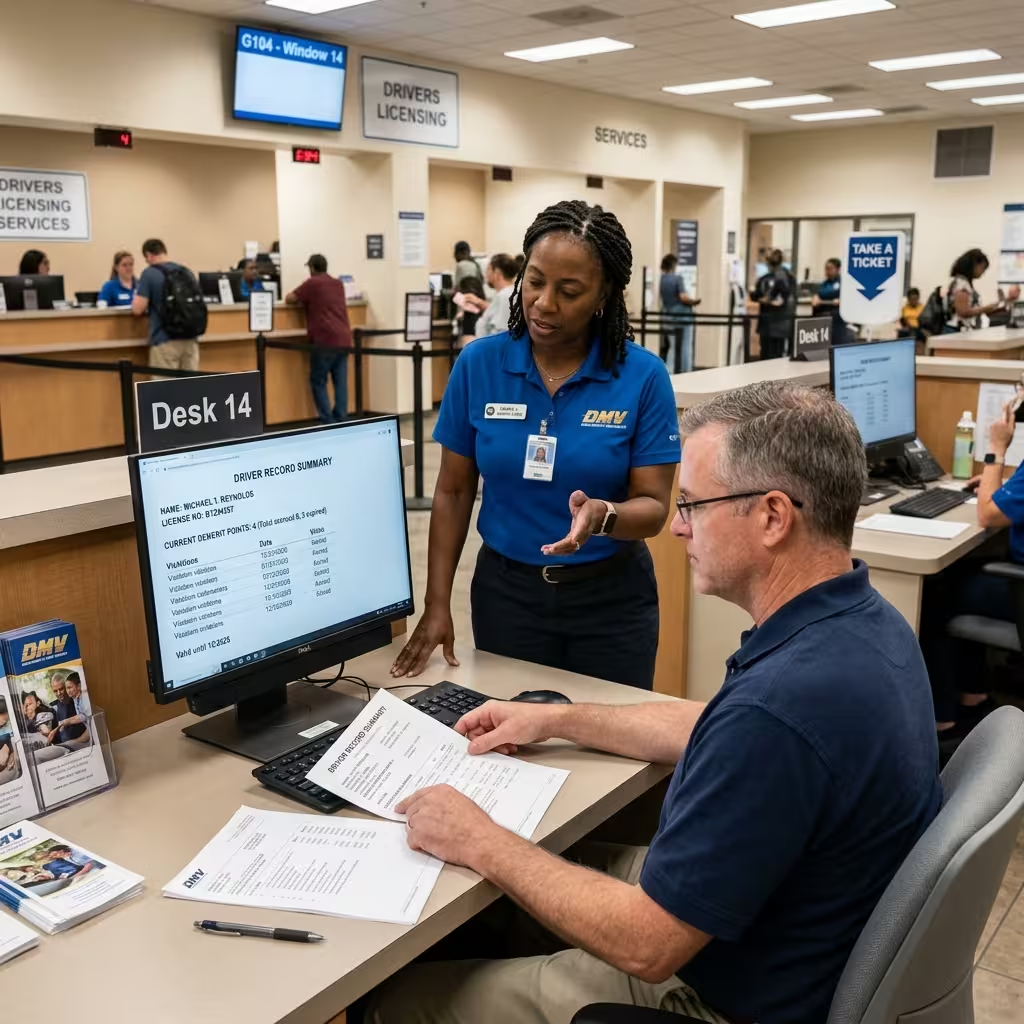
Point accumulation – the one that builds quietly. Rack up enough demerit points from multiple violations within a set window and the DMV classifies you as a habitual offender, even if no single violation was serious. The requirement comes from the pattern in your record, not from any individual event. Administrative, not court-issued.
How do points stack up to the SR-22 level?
Every state runs a demerit point system. Violations earn points. Points build. Hit the threshold and you’re looking at administrative action – which can include SR-22 as a condition of continued or reinstated licensure.
Virginia tracks points on a rolling basis. Build up enough and you’re placed on probation. Commit your first violation while on probation and the typical outcome is a DMV-granted restricted license – with SR-22 attached as a condition of that restricted status.
One speeding ticket won’t do it. Several tickets spread across a few years might. People miscalculate because they treat each violation as settled when the fine is paid. The DMV doesn’t reset your record after each payment. It’s tracking the running total the entire time.
One thing that catches people: out-of-state violations count. The Driver License Compact – 45 states plus D.C. – requires member states to share conviction records and forward them to the driver’s home state. Get a speeding ticket three states over and your home DMV receives it. Pick up a reckless driving charge while traveling through another state – it follows you home and gets added to your point balance there. “It happened out of state” isn’t a defense.
This matters particularly for commercial drivers and anyone with a job that involves frequent travel. One violation per state might seem manageable. Four or five states over a year – all feeding into your home state’s point ledger – and you’ve crossed a threshold without realizing you were anywhere near one.
Can a judge require SR-22 even when the law doesn’t automatically call for it?
Yes, and this gets overlooked constantly.
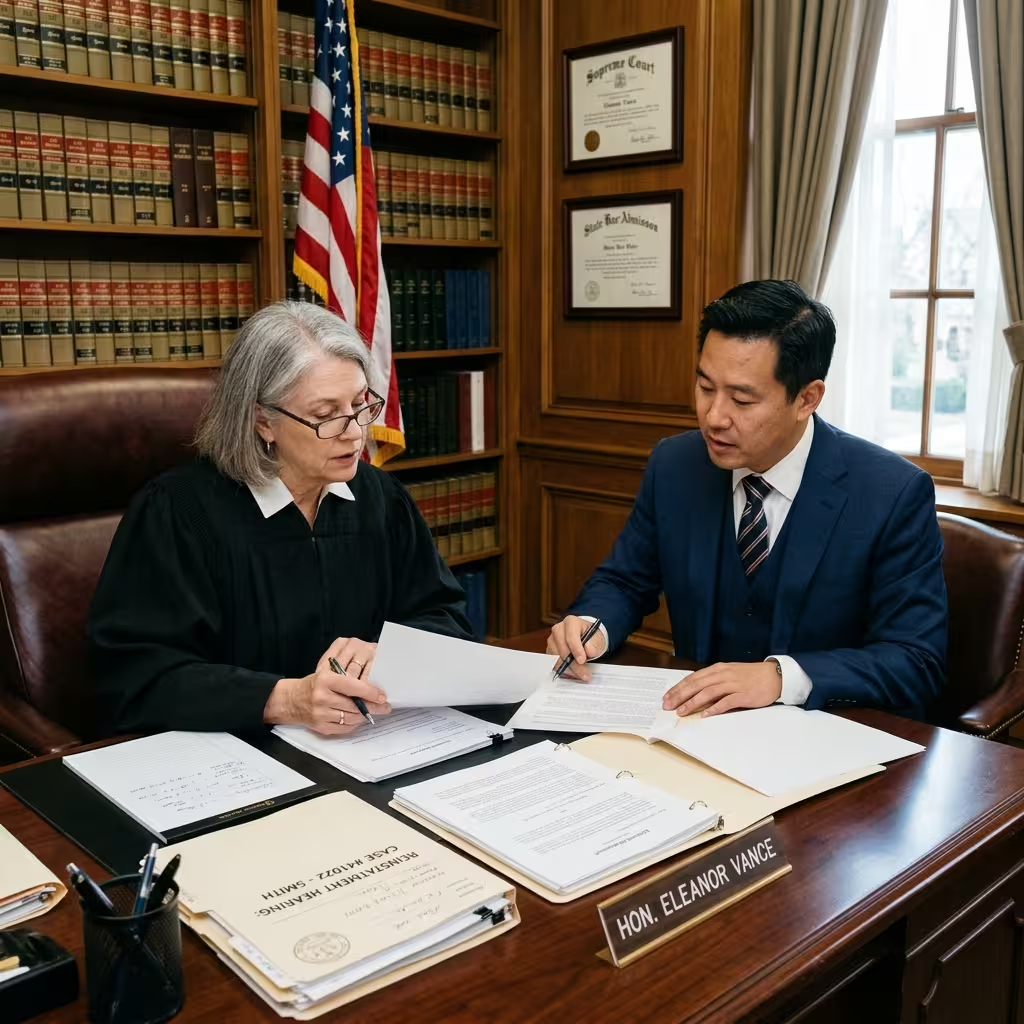
SR-22 requirements come from two separate sources. DMV triggers them automatically – specific violations hit your record, the system generates the requirement. Courts trigger them through sentencing conditions, probation terms, and restricted license approvals. Judges have discretion that extends well past what any statute automatically mandates.
A judge handling a reckless driving case can add SR-22 as a sentencing condition in a state where it isn’t an automatic consequence of that offense. A judge approving restricted driving privileges can make SR-22 a condition of approval. Probation conditions routinely include maintaining proof of financial responsibility – violate those conditions and you’re back in front of that judge, same original requirements still active.
Virginia’s restricted license process illustrates it directly. Getting restricted privileges after a DUI, reckless driving conviction, or drug violation requires petitioning the court. The court sets the terms – not a DMV computer running a checklist. That means a person, with their own read on the situation, decides what you’re required to do. Different judges set different conditions for similar cases.

Does the same offense trigger reasons for SR-22 requirement in every state?
No – and that assumption causes real problems, especially for people who move.
The categories are broadly consistent: DUI, reckless driving, driving uninsured. But when exactly SR-22 triggers, how long it runs, and what minimums it requires vary significantly by state.
| Violation Type | Virginia | Nevada | Tennessee | Utah |
|---|---|---|---|---|
| First DUI / DWI Conviction | FR-44 Required (Double standard liability limits) | Mandatory 3-Year SR-22 Filing | Mandatory 3-Year SR-22 Filing | Mandatory 3-Year SR-22 Filing |
| Uninsured Driving (1st Offense) | Mandatory SR-22 + Reinstatement Fees | $250 Fine Only (No SR-22 if under 30 days) | Mandatory SR-22 Certificate Required | SR-22 Required for License Restoration |
| Reckless Driving Conviction | Mandatory SR-22 (Automatic if over 85 mph) | SR-22 Required for Repeat Offenses | Mandatory SR-22 Certificate Required | SR-22 Imposed upon Court Discretion |
| Drug Offense While Operating Vehicle | Mandatory SR-22 Filing Required | Mandatory SR-22 Filing Required | Mandatory SR-22 for Felony Meth Possession | SR-22 Required if License is Suspended |
| Habitual DMV Point Accumulation | SR-22 Required for Restricted License | SR-22 Required after 3rd Lapse in 5 Years | Mandatory SR-22 for Habitual Offenders | SR-22 Required for High Demerit Totals |
📌 Key State Law Distinctions to Remember:
- The FR-44 Exception: Florida and Virginia do not use standard SR-22s for DUIs; they mandate FR-44 certificates with double the standard liability insurance limits.
- The 30-Day Nevada Rule: Nevada offers a unique grace period for a first insurance lapse under 30 days, requiring only a flat fine instead of an immediate, automatic SR-22 filing.
- Specific Drug Triggers: Tennessee explicitly mandates a strict SR-22 requirement for felony methamphetamine possession specifically while operating a motor vehicle.
Nevada makes the variation concrete. First insurance lapse of 1–30 days: $250 fine, no SR-22. Same lapse duration as a third offense within five years: $750 fine, SR-22, 30-day suspension. The violation didn’t change. The record behind it did.
Same act. Different history. Different state. Different outcome entirely.

What happens after SR-22 is required – mechanically?
Whether the order came from a judge or the DMV, the process runs identically. Find a carrier willing to file SR-22 certificates, they file it electronically with the state DMV, the period clock starts.
Three years of continuous coverage is the standard in most states. Some violations push that to five or beyond. Virginia’s consecutive DUI sanction structure means certain combinations extend the total period well past what you’d calculate by adding the violations separately.
Lapse for any reason – missed payment, cancellation, non-renewal – and your insurer has to file an SR-26 termination notice with the DMV. License suspended, immediately. And in most states, the filing period resets to day one. Not paused. Restarted from scratch.
The SR-22 also doesn’t drop off when the period ends. It stays attached to your policy until you personally contact your insurer and request removal. The high-risk surcharge keeps billing alongside it. Nobody monitors the calendar for you.
Filing fee for the certificate: $15 to $50, paid once. Not the real number. The premium is. Increases run from 30% for a basic insurance lapse to over 100% for DUI or stacked violations, per the financial responsibility research underlying this article. A $1,200 annual policy before a DUI conviction often clears $2,300 after.
Standard carriers regularly decline SR-22 applicants. Texas Automobile Insurance Plan Association (TAIPA) covers the gap – for drivers rejected by at least two voluntary-market insurers within the past 60 days. TAIPA satisfies the SR-22 requirement. The pricing matches the risk level they’re accepting.
Frequently Asked Questions
Can SR-22 be required with zero DUI involvement?
Absolutely – reckless driving, hit-and-run, driving without insurance, street racing, drug possession while driving, excessive point accumulation, and missed child support payments can all lead there depending on the state. DUI is the most frequent trigger, not the exclusive one.
Does every first DUI automatically result in SR-22?
In most states, yes. It’s a standard reinstatement condition. Virginia and Florida take it further with FR-44 – higher required minimums, larger premium impact. The main exception: charges reduced or dismissed before conviction typically don’t activate the automatic trigger.
When does the SR-22 notice arrive after a DUI?
It doesn’t – you won’t receive a notice in the mail. The requirement gets established at sentencing or when you apply to reinstate your license. You contact your insurer, they file, reinstatement proceeds. Tracking it is your responsibility.
Reckless driving – does it always mean SR-22?
Depends on state and prior record. Virginia is aggressive about this: 85 mph anywhere in the state is automatic reckless, and SR-22 commonly follows, especially with a suspension attached. Other states handle a first conviction with fines and points only. Second offense or any conviction paired with a suspension almost always triggers it.
License suspended for unpaid fines – SR-22 required to reinstate?
Not always, but possible. Administrative suspensions from unpaid fines don’t automatically carry SR-22 everywhere. Pull your compliance summary from your state DMV – that document lists what specifically applies to your reinstatement, not the general framework.
Can speeding tickets actually pile up to an SR-22 requirement?
Through point accumulation, yes. No single ticket gets you there – the pattern does. Hit the habitual offender threshold and SR-22 can become a licensure condition. And out-of-state tickets count in the 45 Driver License Compact states. That ticket from your road trip follows you home.
General information only – not legal or insurance advice. SR-22 requirements differ significantly by state, violation type, and driving record. Talk to a licensed insurance professional, attorney, or your state DMV for guidance that fits your actual situation.